Gum Specialist Dubai: Your Complete Guide to Periodontists & Gum Care
Bleeding gums, receding gum lines, or a dentist who mentioned “periodontal disease”? Here’s everything you need to know about finding the right gum specialist in Dubai — what they do, what treatments cost, and when you should book that appointment.
Cross-section of a tooth showing healthy gum versus periodontal disease · Dubai Daily Press
Most of us think about our teeth and forget about the gums holding them in place. Until, that is, something goes wrong — a persistent bleed when brushing, a tooth that feels slightly loose, or a dentist who pauses during a routine check-up and mentions the word “periodontal.” Suddenly, the gum line becomes the most important millimetre of anatomy in your mouth.
If you are in Dubai and facing any of these concerns, you are likely looking for a gum specialist — known clinically as a periodontist. These are dentists who have completed several additional years of specialised training focused entirely on the gums, the bone supporting your teeth, and the tissues surrounding them. They are the experts you see when a regular cleaning is no longer enough.
“Gum disease is silent in its early stages. Most people don’t realise they have it until a dentist points it out — which is why regular check-ups matter so much.”
Dubai Daily Press · June 2026What Exactly Is a Gum Specialist?
A periodontist is a dental specialist who focuses on the prevention, diagnosis, and treatment of conditions affecting the gums and supporting structures of the teeth. After completing a standard dental degree (typically five years), a periodontist undertakes an additional three to four years of postgraduate training specifically in periodontology.
In Dubai, all practising dentists and specialists must be licensed by the Dubai Health Authority (DHA). A qualified gum specialist will hold a recognised postgraduate qualification — usually a Master’s degree, Membership, or Fellowship in periodontology — and will be registered with the DHA as a specialist, not just a general dentist. This distinction matters, because while many general dentists can handle basic gum care, complex cases require the depth of training that only a specialist brings.
Periodontists treat the full spectrum of gum conditions — from mild gingivitis (the earliest, reversible stage) to advanced periodontitis, where bone loss has begun and teeth are at risk. They also perform gum grafts, place dental implants, and carry out cosmetic periodontal procedures like gum contouring.
- Specialist title Periodontist (gum specialist)
- Regulator Dubai Health Authority (DHA)
- Training 5 years dental + 3–4 years specialist
- Consultation AED 300–600 (typical range)
- Insurance Basic plans rarely cover; premium plans may
- Common areas Jumeirah, Downtown, Marina, Al Barsha
- Treatments Deep cleaning, grafts, implants, laser therapy
Signs You Need to See a Gum Specialist
Gum disease is remarkably common — studies suggest that more than half of adults in the UAE have some form of periodontal disease, and many of them don’t know it. The early stages are often painless and easy to ignore. Here are the warning signs that should prompt a visit to a gum specialist:
1. Bleeding Gums
Healthy gums do not bleed when you brush or floss. If you see pink in the sink after brushing, or if your floss comes away bloody, this is your first warning. Bleeding gums are the hallmark of gingivitis — the earliest stage of gum disease — and while gingivitis is reversible, it should never be ignored.
2. Persistent Bad Breath
Halitosis that doesn’t improve with regular brushing and mouthwash is often a sign of bacteria trapped in deep gum pockets. This is one of the most common reasons people are referred to a periodontist.
3. Receding Gums
If your teeth are starting to look longer than they used to, or if you notice sensitivity near the gum line, your gums may be receding. This can be caused by gum disease, aggressive brushing, or genetics — and it doesn’t reverse on its own.
4. Loose or Shifting Teeth
When gum disease progresses to periodontitis, the bone supporting your teeth begins to break down. Teeth may feel loose, shift position, or change the way they fit together when you bite. This is an advanced sign and requires urgent specialist attention.
5. Pus Between Teeth and Gums
Any sign of infection — including pus, swelling, or a bad taste in the mouth — indicates active periodontal disease and should be assessed immediately.
Gum disease has been linked to several serious health conditions beyond the mouth, including heart disease, diabetes complications, stroke, respiratory disease, and adverse pregnancy outcomes. In a city like Dubai, where diabetes rates are high, the connection between oral and general health is particularly important. Managing gum disease can genuinely improve your overall health — not just your smile.
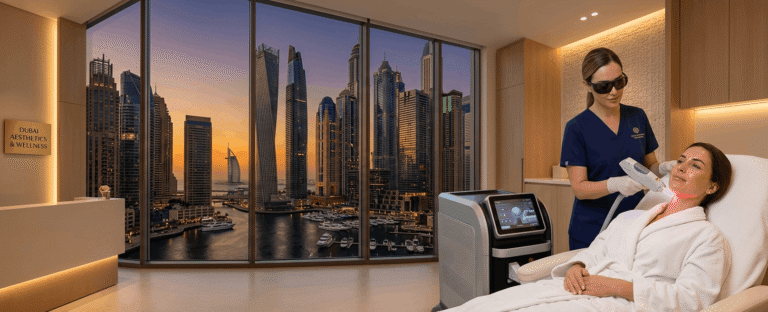
A modern periodontal clinic in Dubai — specialists use digital X-rays, lasers, and 3D imaging to diagnose and treat gum disease precisely · Dubai Daily Press
Treatments Offered by Gum Specialists in Dubai
Dubai’s periodontal clinics are remarkably well-equipped, with many offering the same advanced technologies you would find in leading centres in London, Singapore, or the United States. Here is a breakdown of the treatments you might encounter:
Non-Surgical Treatments
Scaling and root planing (often called “deep cleaning”) is the foundation of periodontal therapy. The specialist removes plaque and tartar from below the gum line and smooths the root surfaces so the gums can reattach. This is usually done under local anaesthesia and may require two to four visits depending on severity.
Laser periodontal therapy is increasingly available in Dubai. Lasers can remove infected tissue with greater precision and often less discomfort than traditional methods. Techniques like LANAP (Laser-Assisted New Attachment Procedure) are offered by several specialist clinics.
Antibiotic therapy — either topical gels placed directly into gum pockets, or oral antibiotics — may be used alongside deep cleaning to control bacterial infection.
Surgical Treatments
When non-surgical treatment is not enough, periodontists perform several types of surgery. Flap surgery (pocket reduction) involves lifting the gums to remove deep tartar and then suturing them back in place. Gum grafts replace receding gum tissue, usually taking tissue from the roof of the mouth or using donor material. Bone grafting rebuilds lost bone to support teeth or prepare for implants.
Dental implant placement is one of the most common procedures performed by periodontists in Dubai. Implants are titanium posts placed into the jawbone to replace missing teeth, and they require the precision and bone expertise that only a specialist can provide.
- Consultation AED 300–600
- X-rays / imaging AED 200–500
- Scaling & root planing AED 1,500–3,500 (full mouth)
- Laser therapy AED 2,000–5,000
- Gum graft (per site) AED 3,000–8,000
- Dental implant AED 6,000–15,000
- Maintenance visit AED 400–800 (every 3–4 months)
Does Insurance Cover Gum Treatment?
This is the question that catches most people out. The short answer is: it depends entirely on your plan. Dubai’s basic health insurance policies typically cover routine dental check-ups and one or two cleanings per year, but exclude periodontal treatment, surgery, and implants entirely.
Premium plans — particularly those offered by insurers like NAS, NextCare, Daman, and Orient on their higher tiers — may cover periodontal treatment up to an annual limit, often between AED 1,500 and AED 5,000. Some corporate plans include more generous dental benefits. Implants are rarely covered unless deemed medically necessary, and even then, approval is not guaranteed.
Before committing to treatment, always ask your clinic to provide a written cost breakdown and check with your insurer about pre-approval. Many clinics offer package deals for extensive treatment (like full-mouth scaling) and some provide interest-free payment plans spread over several months.
“The cheapest dental care is prevention. A six-monthly check-up and clean costs a fraction of what advanced gum treatment will cost you later.”
Dubai Daily Press · Health DeskHow to Choose the Right Gum Specialist
With dozens of dental clinics across Dubai, choosing the right periodontist can feel overwhelming. Here is a practical checklist:
Verify DHA registration. Every legitimate specialist in Dubai must be licensed by the Dubai Health Authority. You can ask to see their certificate or check the DHA’s public register.
Check qualifications. Look for recognised postgraduate qualifications in periodontology — a Master’s, Membership (such as MPerio from a UK royal college), or Fellowship. These indicate genuine specialist training, not just a weekend course.
Consider experience with your condition. If you need implants, ask how many the specialist has placed. If you have complex gum disease, ask about their experience with advanced cases.
Look at the technology. Modern periodontal care relies on digital X-rays, intraoral scanners, 3D cone-beam CT imaging, and often laser technology. A clinic that has invested in these tools is typically one that takes specialist care seriously.
Read reviews — but critically. Patient reviews on Google and social media can be helpful, but look for patterns rather than individual comments. Consistent praise for thoroughness, clear communication, and follow-up care is more meaningful than a handful of five-star reviews.
Trust your consultation. A good periodontist will explain your condition clearly, show you X-rays, discuss all treatment options (including doing nothing, where appropriate), and provide a written treatment plan with costs before you commit. They should never pressure you into immediate treatment.
Prevention: The Best Medicine
While this guide focuses on finding a specialist, the most important message is this: most gum disease is preventable. Brush twice daily with a soft brush, clean between your teeth every day (floss or interdental brushes), avoid smoking and shisha, manage diabetes carefully, and see a dentist every six months for a check-up and clean.
If you do develop gum disease, early treatment is almost always simpler, cheaper, and more successful than late treatment. The gum specialist you may need one day is far less intimidating when you meet them for a routine check rather than an emergency.
• Brush twice daily for two minutes with a soft brush
• Clean between teeth daily (floss or interdental brushes)
• Use an antibacterial mouthwash if recommended
• Replace your toothbrush every 3 months
• Avoid smoking and shisha — both dramatically increase gum disease risk
• See a dentist every 6 months for a check-up and clean
• Watch for bleeding, recession, or bad breath — and act early
Finding Help in Dubai
Dubai has a strong community of qualified periodontists, with specialist clinics in every major area — Jumeirah, Downtown, Dubai Marina, Al Barsha, Arabian Ranches, and the older medical districts around Bur Dubai and Deira. Many hospitals, including American Hospital Dubai, Mediclinic, and NMC, have periodontal departments.
Start with a referral from your general dentist if you have one — they will know which specialists they trust. If you are choosing independently, look for clinics that clearly advertise their periodontal services, list their specialists’ qualifications, and are transparent about costs.
Whatever your situation, remember that gum disease is treatable at every stage. The worst thing you can do is ignore it. The second worst is wait too long. Book that appointment — your future self, and your teeth, will thank you.
Frequently Asked Questions
Everything you need to know about finding and seeing a gum specialist in Dubai.
A gum specialist, known as a periodontist, is a dentist who has completed additional years of specialised training in the prevention, diagnosis, and treatment of diseases affecting the gums and supporting structures of the teeth. They are experts in treating conditions like gingivitis, periodontitis, gum recession, and placing dental implants. In Dubai, periodontists typically hold a recognised postgraduate qualification in periodontology and are licensed by the Dubai Health Authority (DHA).
You should consider seeing a gum specialist if you experience persistent bleeding gums, redness or swelling, receding gums that make teeth look longer, persistent bad breath, loose teeth, pus between teeth and gums, pain when chewing, or changes in how your teeth fit together when biting. If you are a smoker, diabetic, or pregnant, you are at higher risk of gum disease and should have regular periodontal check-ups. Early intervention is key — gum disease is treatable in its early stages but can lead to tooth loss if left untreated.
A consultation with a gum specialist in Dubai typically costs between AED 300 and AED 600 at a private clinic. Initial diagnostic tests like X-rays or panoramic imaging may add AED 200–500. Common treatments range widely: professional cleaning and scaling (AED 400–800), deep cleaning or root planing (AED 1,500–3,500 per quadrant), gum graft surgery (AED 3,000–8,000 per site), and dental implant placement (AED 6,000–15,000 per implant). Many clinics offer package deals and payment plans for extensive treatment.
Coverage varies significantly by insurance provider and plan. Most basic insurance plans in Dubai cover routine dental check-ups and cleanings (usually once or twice a year) but exclude periodontal treatment, gum surgery, and implants. Premium plans may cover periodontal treatment up to a certain annual limit (often AED 1,500–5,000). Implants are rarely covered unless medically necessary. Always check your policy’s dental section and confirm with your insurer before treatment. Some clinics offer direct billing with major insurers like NextCare, NAS, Daman, and Orient.
Gum specialists in Dubai offer a comprehensive range of treatments including: non-surgical treatments like scaling and root planing (deep cleaning), antibiotic therapy, and laser periodontal therapy; surgical treatments including flap surgery, gum grafts (for recession), bone grafting, crown lengthening, and guided tissue regeneration; dental implant placement and restoration; cosmetic periodontics for aesthetic gum contouring; and maintenance programmes for ongoing periodontal care. Many Dubai clinics also offer advanced treatments like pinhole surgical technique for gum recession and LANAP laser therapy.
When choosing a gum specialist in Dubai, verify their DHA licence and check for recognised postgraduate qualifications in periodontology (such as a Master’s or Fellowship). Look for experience with your specific condition, read patient reviews, and consider the clinic’s technology (digital X-rays, laser equipment, 3D imaging). A good periodontist will explain treatment options clearly, provide a written treatment plan with costs, and not rush you into unnecessary procedures. Recommendations from your general dentist are often a reliable starting point.
Yes, gum disease is very common in Dubai and across the UAE, as it is worldwide. Studies suggest that over 50% of adults in the UAE have some form of periodontal disease. Risk factors prevalent in the region include high rates of diabetes, smoking and shisha use, stress, and in some cases, limited access to regular dental care. The hot climate and certain dietary habits can also contribute. Regular dental check-ups every six months are strongly recommended for early detection and prevention.
Gingivitis (early gum disease) can be completely reversed with professional cleaning and improved oral hygiene. However, periodontitis (advanced gum disease) cannot be fully cured because the bone and tissue damage is often irreversible. It can, however, be successfully managed and stabilised with proper treatment and ongoing maintenance. The goal of periodontal treatment is to halt disease progression, preserve existing bone and tissue, and prevent tooth loss. Patients who complete active treatment and commit to regular maintenance visits can keep their teeth for life.
Gum Specialist Dubai: Your Complete Guide to Periodontists & Gum Care
Bleeding gums, receding gum lines, or a dentist who mentioned “periodontal disease”? Here’s everything you need to know about finding the right gum specialist in Dubai — what they do, what treatments cost, and when you should book that appointment.
Cross-section of a tooth showing healthy gum versus periodontal disease · Dubai Daily Press
Most of us think about our teeth and forget about the gums holding them in place. Until, that is, something goes wrong — a persistent bleed when brushing, a tooth that feels slightly loose, or a dentist who pauses during a routine check-up and mentions the word “periodontal.” Suddenly, the gum line becomes the most important millimetre of anatomy in your mouth.
If you are in Dubai and facing any of these concerns, you are likely looking for a gum specialist — known clinically as a periodontist. These are dentists who have completed several additional years of specialised training focused entirely on the gums, the bone supporting your teeth, and the tissues surrounding them. They are the experts you see when a regular cleaning is no longer enough.
“Gum disease is silent in its early stages. Most people don’t realise they have it until a dentist points it out — which is why regular check-ups matter so much.”
Dubai Daily Press · June 2026What Exactly Is a Gum Specialist?
A periodontist is a dental specialist who focuses on the prevention, diagnosis, and treatment of conditions affecting the gums and supporting structures of the teeth. After completing a standard dental degree (typically five years), a periodontist undertakes an additional three to four years of postgraduate training specifically in periodontology.
In Dubai, all practising dentists and specialists must be licensed by the Dubai Health Authority (DHA). A qualified gum specialist will hold a recognised postgraduate qualification — usually a Master’s degree, Membership, or Fellowship in periodontology — and will be registered with the DHA as a specialist, not just a general dentist. This distinction matters, because while many general dentists can handle basic gum care, complex cases require the depth of training that only a specialist brings.
Periodontists treat the full spectrum of gum conditions — from mild gingivitis (the earliest, reversible stage) to advanced periodontitis, where bone loss has begun and teeth are at risk. They also perform gum grafts, place dental implants, and carry out cosmetic periodontal procedures like gum contouring.
- Specialist title Periodontist (gum specialist)
- Regulator Dubai Health Authority (DHA)
- Training 5 years dental + 3–4 years specialist
- Consultation AED 300–600 (typical range)
- Insurance Basic plans rarely cover; premium plans may
- Common areas Jumeirah, Downtown, Marina, Al Barsha
- Treatments Deep cleaning, grafts, implants, laser therapy
Signs You Need to See a Gum Specialist
Gum disease is remarkably common — studies suggest that more than half of adults in the UAE have some form of periodontal disease, and many of them don’t know it. The early stages are often painless and easy to ignore. Here are the warning signs that should prompt a visit to a gum specialist:
1. Bleeding Gums
Healthy gums do not bleed when you brush or floss. If you see pink in the sink after brushing, or if your floss comes away bloody, this is your first warning. Bleeding gums are the hallmark of gingivitis — the earliest stage of gum disease — and while gingivitis is reversible, it should never be ignored.
2. Persistent Bad Breath
Halitosis that doesn’t improve with regular brushing and mouthwash is often a sign of bacteria trapped in deep gum pockets. This is one of the most common reasons people are referred to a periodontist.
3. Receding Gums
If your teeth are starting to look longer than they used to, or if you notice sensitivity near the gum line, your gums may be receding. This can be caused by gum disease, aggressive brushing, or genetics — and it doesn’t reverse on its own.
4. Loose or Shifting Teeth
When gum disease progresses to periodontitis, the bone supporting your teeth begins to break down. Teeth may feel loose, shift position, or change the way they fit together when you bite. This is an advanced sign and requires urgent specialist attention.
5. Pus Between Teeth and Gums
Any sign of infection — including pus, swelling, or a bad taste in the mouth — indicates active periodontal disease and should be assessed immediately.
Gum disease has been linked to several serious health conditions beyond the mouth, including heart disease, diabetes complications, stroke, respiratory disease, and adverse pregnancy outcomes. In a city like Dubai, where diabetes rates are high, the connection between oral and general health is particularly important. Managing gum disease can genuinely improve your overall health — not just your smile.
A modern periodontal clinic in Dubai — specialists use digital X-rays, lasers, and 3D imaging to diagnose and treat gum disease precisely · Dubai Daily Press
Treatments Offered by Gum Specialists in Dubai
Dubai’s periodontal clinics are remarkably well-equipped, with many offering the same advanced technologies you would find in leading centres in London, Singapore, or the United States. Here is a breakdown of the treatments you might encounter:
Non-Surgical Treatments
Scaling and root planing (often called “deep cleaning”) is the foundation of periodontal therapy. The specialist removes plaque and tartar from below the gum line and smooths the root surfaces so the gums can reattach. This is usually done under local anaesthesia and may require two to four visits depending on severity.
Laser periodontal therapy is increasingly available in Dubai. Lasers can remove infected tissue with greater precision and often less discomfort than traditional methods. Techniques like LANAP (Laser-Assisted New Attachment Procedure) are offered by several specialist clinics.
Antibiotic therapy — either topical gels placed directly into gum pockets, or oral antibiotics — may be used alongside deep cleaning to control bacterial infection.
Surgical Treatments
When non-surgical treatment is not enough, periodontists perform several types of surgery. Flap surgery (pocket reduction) involves lifting the gums to remove deep tartar and then suturing them back in place. Gum grafts replace receding gum tissue, usually taking tissue from the roof of the mouth or using donor material. Bone grafting rebuilds lost bone to support teeth or prepare for implants.
Dental implant placement is one of the most common procedures performed by periodontists in Dubai. Implants are titanium posts placed into the jawbone to replace missing teeth, and they require the precision and bone expertise that only a specialist can provide.
- Consultation AED 300–600
- X-rays / imaging AED 200–500
- Scaling & root planing AED 1,500–3,500 (full mouth)
- Laser therapy AED 2,000–5,000
- Gum graft (per site) AED 3,000–8,000
- Dental implant AED 6,000–15,000
- Maintenance visit AED 400–800 (every 3–4 months)
Does Insurance Cover Gum Treatment?
This is the question that catches most people out. The short answer is: it depends entirely on your plan. Dubai’s basic health insurance policies typically cover routine dental check-ups and one or two cleanings per year, but exclude periodontal treatment, surgery, and implants entirely.
Premium plans — particularly those offered by insurers like NAS, NextCare, Daman, and Orient on their higher tiers — may cover periodontal treatment up to an annual limit, often between AED 1,500 and AED 5,000. Some corporate plans include more generous dental benefits. Implants are rarely covered unless deemed medically necessary, and even then, approval is not guaranteed.
Before committing to treatment, always ask your clinic to provide a written cost breakdown and check with your insurer about pre-approval. Many clinics offer package deals for extensive treatment (like full-mouth scaling) and some provide interest-free payment plans spread over several months.
“The cheapest dental care is prevention. A six-monthly check-up and clean costs a fraction of what advanced gum treatment will cost you later.”
Dubai Daily Press · Health DeskHow to Choose the Right Gum Specialist
With dozens of dental clinics across Dubai, choosing the right periodontist can feel overwhelming. Here is a practical checklist:
Verify DHA registration. Every legitimate specialist in Dubai must be licensed by the Dubai Health Authority. You can ask to see their certificate or check the DHA’s public register.
Check qualifications. Look for recognised postgraduate qualifications in periodontology — a Master’s, Membership (such as MPerio from a UK royal college), or Fellowship. These indicate genuine specialist training, not just a weekend course.
Consider experience with your condition. If you need implants, ask how many the specialist has placed. If you have complex gum disease, ask about their experience with advanced cases.
Look at the technology. Modern periodontal care relies on digital X-rays, intraoral scanners, 3D cone-beam CT imaging, and often laser technology. A clinic that has invested in these tools is typically one that takes specialist care seriously.
Read reviews — but critically. Patient reviews on Google and social media can be helpful, but look for patterns rather than individual comments. Consistent praise for thoroughness, clear communication, and follow-up care is more meaningful than a handful of five-star reviews.
Trust your consultation. A good periodontist will explain your condition clearly, show you X-rays, discuss all treatment options (including doing nothing, where appropriate), and provide a written treatment plan with costs before you commit. They should never pressure you into immediate treatment.
Prevention: The Best Medicine
While this guide focuses on finding a specialist, the most important message is this: most gum disease is preventable. Brush twice daily with a soft brush, clean between your teeth every day (floss or interdental brushes), avoid smoking and shisha, manage diabetes carefully, and see a dentist every six months for a check-up and clean.
If you do develop gum disease, early treatment is almost always simpler, cheaper, and more successful than late treatment. The gum specialist you may need one day is far less intimidating when you meet them for a routine check rather than an emergency.
• Brush twice daily for two minutes with a soft brush
• Clean between teeth daily (floss or interdental brushes)
• Use an antibacterial mouthwash if recommended
• Replace your toothbrush every 3 months
• Avoid smoking and shisha — both dramatically increase gum disease risk
• See a dentist every 6 months for a check-up and clean
• Watch for bleeding, recession, or bad breath — and act early
Finding Help in Dubai
Dubai has a strong community of qualified periodontists, with specialist clinics in every major area — Jumeirah, Downtown, Dubai Marina, Al Barsha, Arabian Ranches, and the older medical districts around Bur Dubai and Deira. Many hospitals, including American Hospital Dubai, Mediclinic, and NMC, have periodontal departments.
Start with a referral from your general dentist if you have one — they will know which specialists they trust. If you are choosing independently, look for clinics that clearly advertise their periodontal services, list their specialists’ qualifications, and are transparent about costs.
Whatever your situation, remember that gum disease is treatable at every stage. The worst thing you can do is ignore it. The second worst is wait too long. Book that appointment — your future self, and your teeth, will thank you.
Frequently Asked Questions
Everything you need to know about finding and seeing a gum specialist in Dubai.
A gum specialist, known as a periodontist, is a dentist who has completed additional years of specialised training in the prevention, diagnosis, and treatment of diseases affecting the gums and supporting structures of the teeth. They are experts in treating conditions like gingivitis, periodontitis, gum recession, and placing dental implants. In Dubai, periodontists typically hold a recognised postgraduate qualification in periodontology and are licensed by the Dubai Health Authority (DHA).
You should consider seeing a gum specialist if you experience persistent bleeding gums, redness or swelling, receding gums that make teeth look longer, persistent bad breath, loose teeth, pus between teeth and gums, pain when chewing, or changes in how your teeth fit together when biting. If you are a smoker, diabetic, or pregnant, you are at higher risk of gum disease and should have regular periodontal check-ups. Early intervention is key — gum disease is treatable in its early stages but can lead to tooth loss if left untreated.
A consultation with a gum specialist in Dubai typically costs between AED 300 and AED 600 at a private clinic. Initial diagnostic tests like X-rays or panoramic imaging may add AED 200–500. Common treatments range widely: professional cleaning and scaling (AED 400–800), deep cleaning or root planing (AED 1,500–3,500 per quadrant), gum graft surgery (AED 3,000–8,000 per site), and dental implant placement (AED 6,000–15,000 per implant). Many clinics offer package deals and payment plans for extensive treatment.
Coverage varies significantly by insurance provider and plan. Most basic insurance plans in Dubai cover routine dental check-ups and cleanings (usually once or twice a year) but exclude periodontal treatment, gum surgery, and implants. Premium plans may cover periodontal treatment up to a certain annual limit (often AED 1,500–5,000). Implants are rarely covered unless medically necessary. Always check your policy’s dental section and confirm with your insurer before treatment. Some clinics offer direct billing with major insurers like NextCare, NAS, Daman, and Orient.
Gum specialists in Dubai offer a comprehensive range of treatments including: non-surgical treatments like scaling and root planing (deep cleaning), antibiotic therapy, and laser periodontal therapy; surgical treatments including flap surgery, gum grafts (for recession), bone grafting, crown lengthening, and guided tissue regeneration; dental implant placement and restoration; cosmetic periodontics for aesthetic gum contouring; and maintenance programmes for ongoing periodontal care. Many Dubai clinics also offer advanced treatments like pinhole surgical technique for gum recession and LANAP laser therapy.
When choosing a gum specialist in Dubai, verify their DHA licence and check for recognised postgraduate qualifications in periodontology (such as a Master’s or Fellowship). Look for experience with your specific condition, read patient reviews, and consider the clinic’s technology (digital X-rays, laser equipment, 3D imaging). A good periodontist will explain treatment options clearly, provide a written treatment plan with costs, and not rush you into unnecessary procedures. Recommendations from your general dentist are often a reliable starting point.
Yes, gum disease is very common in Dubai and across the UAE, as it is worldwide. Studies suggest that over 50% of adults in the UAE have some form of periodontal disease. Risk factors prevalent in the region include high rates of diabetes, smoking and shisha use, stress, and in some cases, limited access to regular dental care. The hot climate and certain dietary habits can also contribute. Regular dental check-ups every six months are strongly recommended for early detection and prevention.
Gingivitis (early gum disease) can be completely reversed with professional cleaning and improved oral hygiene. However, periodontitis (advanced gum disease) cannot be fully cured because the bone and tissue damage is often irreversible. It can, however, be successfully managed and stabilised with proper treatment and ongoing maintenance. The goal of periodontal treatment is to halt disease progression, preserve existing bone and tissue, and prevent tooth loss. Patients who complete active treatment and commit to regular maintenance visits can keep their teeth for life.